Help/Support
 Let’s get started

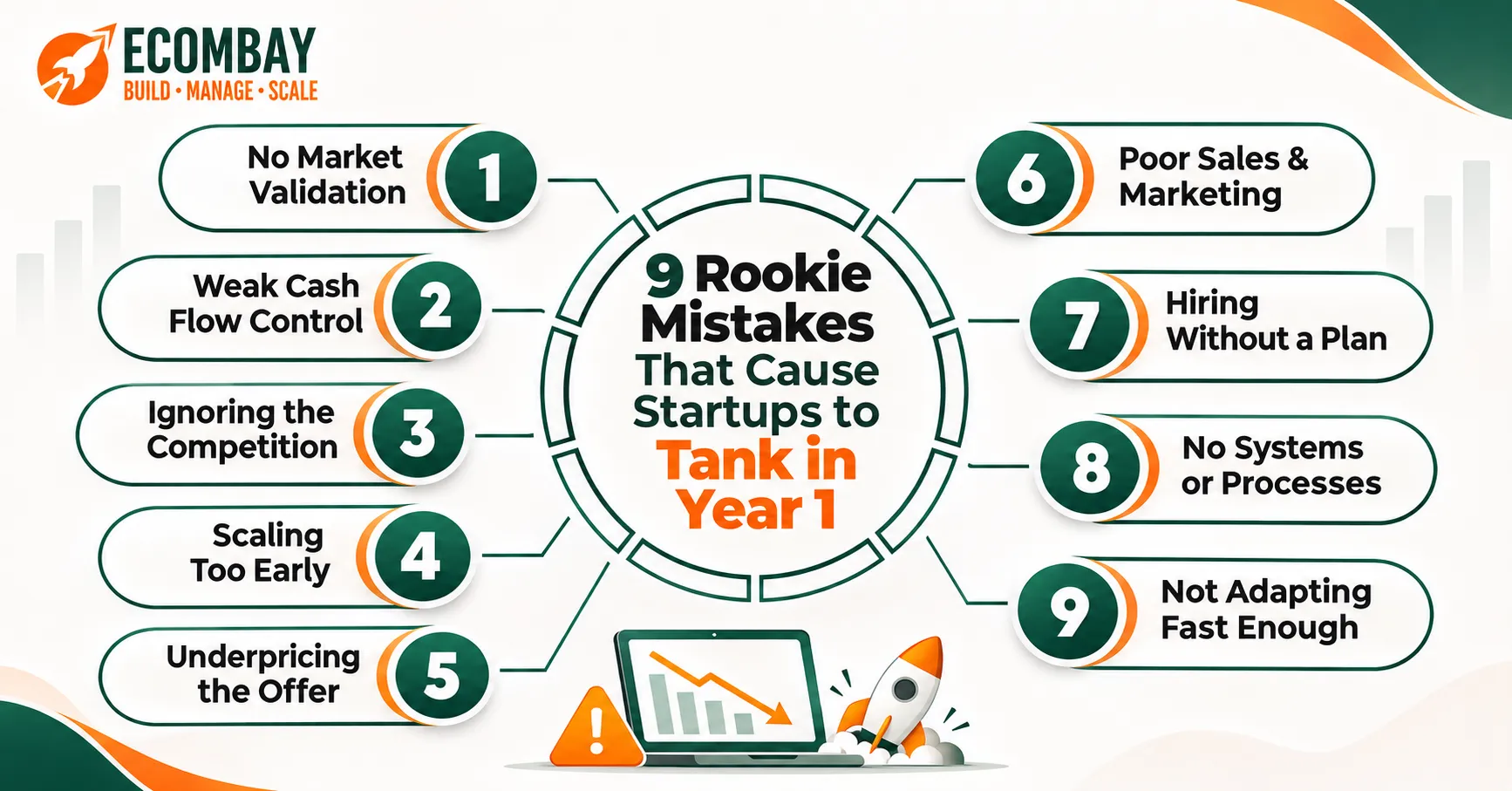
The first year of a startup is rarely destroyed by one dramatic disaster. More often, it is weakened by small decisions that quietly consume cash, confuse customers, and exhaust founders.
The numbers are serious, but not as hopeless as internet myths suggest. According to the latest U.S. Bureau of Labor Statistics business survival data, approximately 78% of establishments opened in the year ending March 2024 survived their first year. That means roughly one in five did not.
For ecommerce founders, understanding the most important startup mistakes to avoid can be the difference between building a scalable store and closing before the brand gains momentum. Save this checklist, revisit it every quarter, and make sure these nine problems are not quietly growing inside your business.
Launching Before Validating Demand
A clever product idea is not the same as proven customer demand. New founders often purchase inventory because they personally like a product, a supplier recommends it, or a competitor appears successful.
Before investing heavily, study search demand, customer reviews, pricing patterns, competitor sales, and recurring complaints. Run a small test order or limited campaign first. Validation will not remove every risk, but it can stop a weak product from consuming your startup budget.
Simple fix: Test demand with data and a small inventory commitment before scaling.
Trying to Sell to Everyone
When a brand targets everyone, its message rarely connects with anyone. Broad phrases such as “high-quality products at affordable prices” do not explain why customers should choose one store over hundreds of alternatives.
Define a specific buyer, problem, desired outcome, and reason to believe. Clear positioning improves product selection, advertising, website copy, creative direction, and customer retention.
Simple fix: Build your offer around one clearly defined customer before expanding.
Ignoring Unit Economics
Revenue looks exciting on a dashboard, but it does not guarantee profit. One of the most dangerous startup mistakes is calculating profit using only the product cost and selling price.
Real unit economics should include shipping, packaging, platform fees, payment processing, advertising, discounts, returns, storage, software, and fulfillment. A product generating sales can still drain cash with every order.
Simple fix: Calculate contribution margin per order and review it every week.
Spending Too Much Before Product-Market Fit
A polished logo, expensive website, oversized inventory order, and premium software stack can make a startup feel established. None of them can rescue an unwanted product.
Early spending should help founders learn, sell, fulfill, or retain customers. Everything else should be questioned. Preserve cash until the business has repeatable evidence that people want the offer.
Simple fix: Separate essential growth expenses from purchases that only make the company look bigger.
Choosing Suppliers on Price Alone
The cheapest supplier can become the most expensive decision in the business. Poor quality, inconsistent production, weak packaging, delayed shipments, and unclear communication can create refunds and negative reviews.
Request samples, verify specifications, inspect packaging, discuss lead times, and document quality expectations. When possible, identify a backup supplier before the primary relationship becomes a crisis.
Simple fix: Evaluate suppliers on reliability, quality, communication, and total landed cost.
Launching Without a Customer-Acquisition Plan
“Post on social media and wait” is not a strategy. A startup needs a realistic plan for bringing qualified visitors to its store through paid advertising, search, creators, marketplaces, email, partnerships, or organic content.
Choose one or two primary channels, define the budget, and establish measurable targets. Track customer acquisition cost, conversion rate, average order value, and repeat purchases.
Simple fix: Decide how customers will discover the brand before launching it.
Confusing Activity With Progress
Founders can spend entire weeks redesigning pages, testing apps, attending meetings, or adjusting minor details without improving sales. Busy work feels productive because it is comfortable and visible.
Revenue-producing priorities are usually simpler: improving the offer, speaking with customers, testing creative, fixing conversion leaks, and strengthening fulfillment.
Simple fix: Identify the three weekly actions most likely to improve revenue, margin, or retention.
Scaling Before Operations Are Ready
A successful campaign can expose every weakness in a young business. Inventory disappears, customer messages accumulate, orders arrive late, and refund requests increase.
Document order processing, customer support, inventory monitoring, returns, and escalation procedures before increasing advertising spend. Growth should multiply a reliable system, not amplify disorder.
Simple fix: Stress-test operations with controlled volume before accelerating traffic.
Refusing to Adapt
Founders naturally become attached to their first product, price, supplier, or marketing idea. Customers do not share that attachment. They respond according to value, trust, convenience, and relevance.
Treat weak results as information. Review customer questions, abandoned carts, returns, reviews, and campaign performance. The companies that survive are often not those with perfect first ideas, but those that learn quickly.
Simple fix: Set monthly review points and change what the evidence says is not working.
Why Choose EcomBay?
Avoiding common mistakes in startups becomes easier when research, sourcing, operations, marketing, and performance management work together as one connected system. EcomBay helps entrepreneurs build and grow ecommerce businesses with stronger foundations, streamlined operations, and strategies designed for sustainable growth.
- Data-Driven Product Research: We help identify viable product opportunities by evaluating demand, competition, pricing, customer behavior, and market potential before major investments are made.
- Reliable Sourcing & Supplier Support: From evaluating suppliers to improving product quality and fulfillment planning, we help reduce sourcing risks that can hurt margins and customer satisfaction.
- Professional Store Setup & Management: We support entrepreneurs in building, organizing, and managing ecommerce stores with efficient systems that make daily operations easier to control.
- Growth-Focused Marketing Strategies: Our approach connects customer acquisition, advertising, conversion optimization, and marketplace growth so businesses can focus on measurable revenue rather than disconnected activities.
- Scalable Ecommerce Operations: We help create organized processes for inventory, fulfillment, performance monitoring, and ongoing optimization so growing businesses can scale without creating operational chaos.
The Bottom Line
Surviving year one requires more than enthusiasm. It requires validated demand, controlled spending, healthy margins, reliable operations, and the willingness to respond quickly when the market disagrees with the original plan.
Frequently Asked Questions
What are the top 10 mistakes that startups make?
The top mistakes include failing to validate demand, targeting everyone, ignoring margins, overspending, choosing unreliable suppliers, lacking an acquisition plan, prioritizing busy work, scaling too early, ignoring customer feedback, and refusing to adapt.
What are the 10 most common reasons why startups fail?
Common reasons include insufficient demand, cash-flow problems, weak pricing, poor product quality, ineffective marketing, founder disagreements, operational failures, strong competition, premature scaling, and slow adaptation.
What is the #1 mistake startups can make?
The biggest mistake is building without validating a genuine customer problem. If meaningful demand does not exist, better branding or advertising will only accelerate losses.
Is it true that 90% of startups fail?
Not as a universal first-year statistic. Failure rates vary by business type, definition, country, funding model, and timeframe. Official U.S. establishment data shows that roughly four out of five new establishments survive their first year.
What is the 80/20 rule for startups?
The 80/20 rule suggests that approximately 80% of results may come from 20% of activities, customers, products, or campaigns. Founders can use it to prioritize their highest-performing products and growth channels.
Why do 99% of startups fail?
There is no reliable evidence that 99% of all startups fail. The claim is usually exaggerated or based on a narrowly defined group. Founders should rely on credible survival data instead of viral statistics.